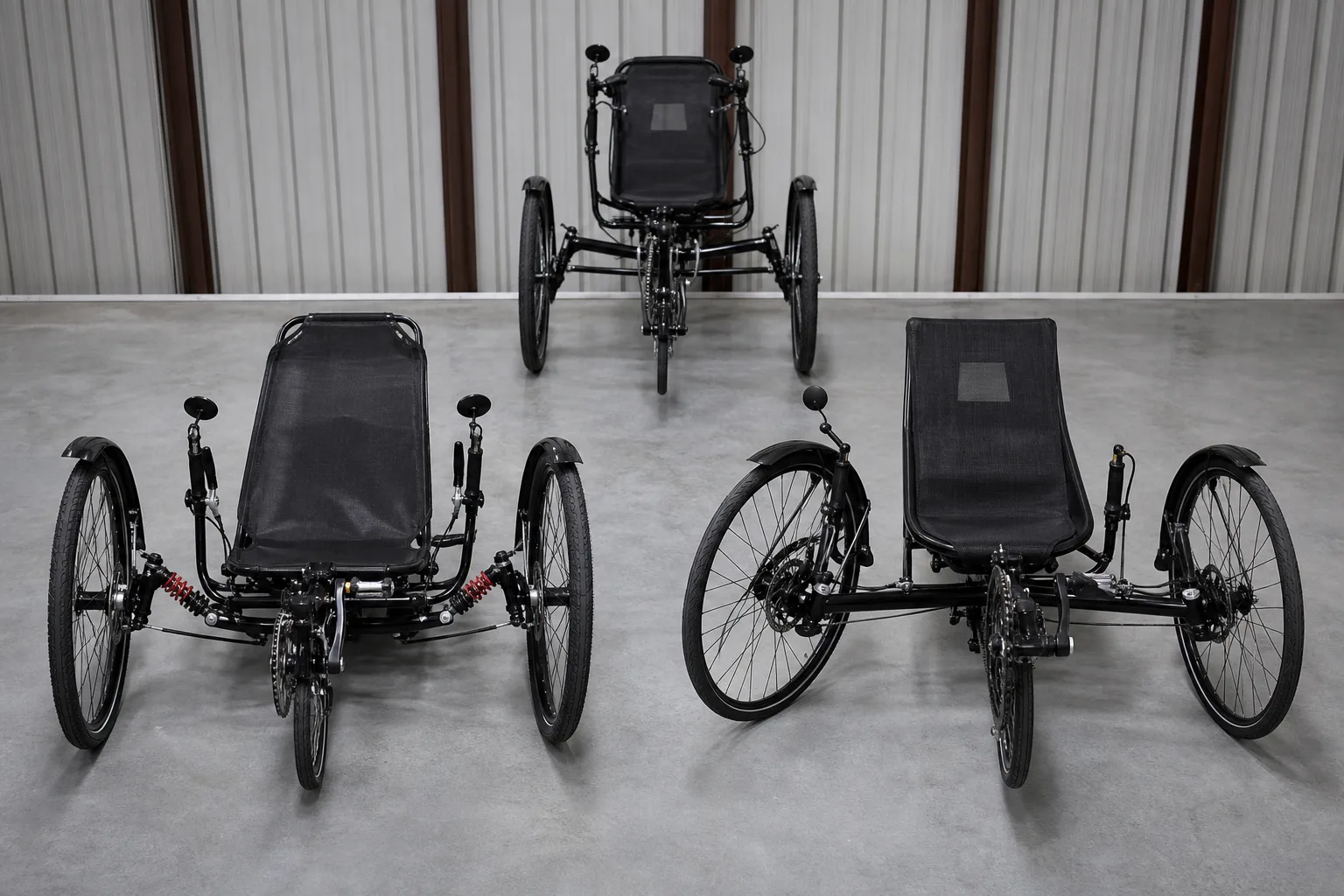
Delta or tadpole? What to measure before your first fast corner
Wheel layout, track width and seat height decide how an adult trike behaves in a turn, and all three are printable numbers you can check before you buy.
A two-wheeler solves cornering by leaning, which quietly moves the combined weight of rider and machine into the turn until gravity and cornering force line up through the tires. A trike cannot do that. It stays flat, and the sideways force has to be resisted by the width between its wheels, working against the height of the load above them. That single difference explains nearly everything a new trike owner finds surprising in the first month, and it is measurable in advance, from numbers most serious builders print on the spec sheet.
Where the third wheel goes, and what that does to a turn
A delta has one wheel in front and two behind. A tadpole has two in front and one behind. The difference matters most in the moment a turn tightens, because a delta carries its steered wheel out front alone and its mass behind, which tends to push the rear outward and the front around, while a tadpole steers with the two loaded wheels and trails a single wheel that follows. Tadpoles generally hold a line longer before anything lets go. Deltas usually turn tighter in a parking lot, which is its own kind of useful.
Neither layout is safer as a category, and treating them that way leads people to buy on a label rather than on geometry. What actually decides the behavior is the triangle each layout makes on the ground and where the rider sits inside it. On a tadpole, the stable base is broad at the front, near the steering, and narrows toward the back. On a delta it is the reverse, narrow where you steer and broad where the weight already is. Read the frame that way and the handling stops being mysterious.
Track width and seat height, the two numbers that matter
Track is the distance between the centers of the paired wheels, and it is the lever arm resisting a rollover. Seat height, measured from the ground to the lowest point of the seat pan, sets how high the mass sits above that lever. A careful reader looks for both, in inches, in the specifications, and treats a listing that omits them as incomplete rather than as an oversight. Roughly speaking, a wide track with a low seat tolerates far more speed in a given corner than a narrow track with an upright seat, and the relationship is not gentle: small changes in either produce large changes in the speed at which an inside wheel starts to unload.
Upright seating puts your torso high, which is easy to mount, easy to see over in traffic, and comparatively tippy. Recumbent seating lays you back and low, sometimes with the seat pan only a few inches above the pavement, which raises cornering limits substantially and makes the machine harder to get into and out of. The trade is real and it is personal. Someone with hip or knee limitations may correctly choose the higher seat and simply ride corners slower, which is a decision, not a compromise forced on them.
Speed, camber and the wheel that comes up
Cornering force rises with the square of speed, so a turn taken at twelve miles per hour asks roughly four times as much of the trike as the same turn at six. That is why the first wheel lift almost always happens somewhere familiar, on a corner ridden a dozen times slower without incident. Road camber compounds it. Pavement crowned for drainage tilts you outward on a right turn from the crown, effectively shortening the track that is holding you down, and a driveway apron or a banked shoulder can do the same thing in the middle of a maneuver.
The response that works is unglamorous and quickly becomes automatic: brake before the turn rather than in it, lean your shoulders and head toward the inside of the corner, and let the lifting wheel tell you to ease off rather than waiting for anything more dramatic. The Consumer Product Safety Commission oversees safety requirements for bicycles sold in the United States, and reputable trike builders design to that framework, but no standard substitutes for knowing your own machine's limit on an empty street.
Finding the limit on purpose
An empty parking lot, a helmet, and twenty minutes will tell you more than any review. Ride steady circles at increasing speed until the inside wheel goes light, note the speed, then do it in the other direction, because camber and your own asymmetry will make the two numbers differ. Repeat it loaded, with groceries or panniers in place, since cargo carried high above the axle line moves the limit down noticeably. After that the trike becomes predictable, and predictable is the whole point.
A delta trike has one wheel at the front and two at the rear. It usually offers a tighter turning circle and easier mounting, since the seat tends to sit higher and further back.