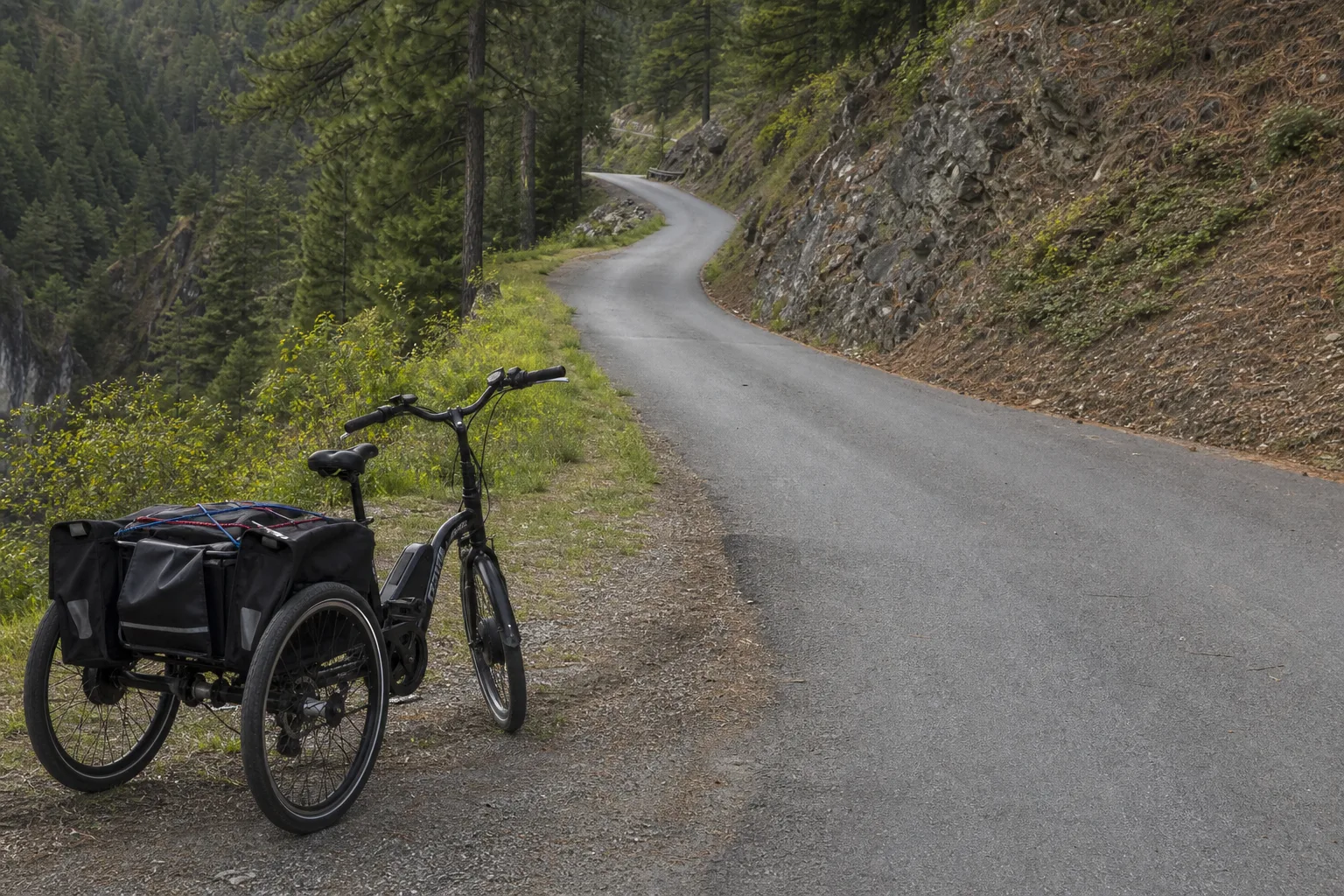
Loaded trike, one steep hill. How much motor you actually need
Hub against mid-drive on a machine that cannot lean, why torque matters more than watt ratings on the hill you ride daily, and what battery capacity means at seventy pounds unloaded.
The specification sheet says 750 watts, and the hill behind the grocery store does not care. A trike arrives already heavy, often seventy pounds before anything is loaded into the basket, and the physics of moving that weight uphill from a dead stop at four miles an hour is a different problem from the one solved by a two-wheeler that can stand on the pedals and sway. What a careful reader checks, before spending, is not the headline wattage but where the motor sits, what it does at low crank speed, and how much energy the pack holds relative to a frame that never gets lighter.
Where the motor sits, on a frame that stays upright
A hub motor drives the wheel directly, at one fixed ratio, which means the gears on the trike change what your legs do and nothing about what the motor does. On flat ground and moderate grades this is fine, quiet, and nearly maintenance-free, since the motor is sealed inside a wheel and the chain sees no extra load. On a long steep climb at low speed it is working outside its efficient band, drawing current and making heat rather than progress. A mid-drive puts its output through the same chain and cassette you pedal, so the climbing gear that helps your knees helps the motor too.
The trade is real and worth naming. Mid-drives chew through chains and rear cogs faster, particularly on a delta layout where the drive geometry is already unusual and replacement parts are less generic than on a bicycle. Hub motors, on a tadpole trike with the motor in a rear wheel, are simpler to live with and simpler to have serviced by a shop that has never seen your model before. Rear-hub placement also keeps the front wheels doing steering only, which on a machine that cannot lean is a quieter, more predictable thing to feel through the bars.
Torque, wattage, and the hill you ride every week
Wattage is a rating, often a nominal figure with a peak number beside it, and two motors labeled the same can behave very differently under load. The number that predicts hill performance is torque, quoted in newton meters, because torque is what turns a stationary loaded trike into a moving one. A useful test is not the spec sheet but the single worst grade on your regular route: the driveway, the bridge approach, the block between the pharmacy and home. Ride it loaded, at the speed you would actually ride it, and watch whether the motor holds a steady pull or surges and fades.
Heat is the second-order effect people discover late. A hub motor lugging up a long grade at walking pace sheds heat poorly, and controllers protect themselves by cutting power, which arrives as a sudden loss of assist partway up. A mid-drive spinning faster in a low gear stays cooler doing the same work. If the one hill that matters is short, either will do. If it is a half mile of sustained climb with sixty pounds of groceries and a rider aboard, gear reduction is the honest answer.
Battery capacity against a frame that starts heavy
Capacity is watt-hours, voltage multiplied by amp-hours, and that single number is more informative than either figure alone. On a trike the useful reading is watt-hours per mile under your conditions, which runs higher than a bicycle's simply because there is a third wheel, more frame, more rolling resistance, and more cargo. The Department of Energy oversees battery technology and efficiency standards in the United States, and the practical consequence for a rider is that pack size determines whether you finish the return trip on assist or pedal the last two miles unpowered on a heavy machine.
Check where the pack mounts, whether it removes for charging indoors, and how much it weighs, because a battery you cannot lift off is a battery that dictates where the trike sleeps. Check the charge time too. A larger pack charged on a small charger can take most of a day, which matters if the trike is transportation rather than recreation.
Standing start, throttle, and what assist feels like
From a standstill a trike does not need balance, so a throttle is genuinely useful in a way it is not on a two-wheeler: crossing an intersection, pulling out of a driveway, restarting on a grade. Cadence sensors wait for the cranks to turn before delivering power, which produces a brief lag and then a shove. Torque sensors read pedal pressure and respond immediately and proportionally, which feels smoother and drains the pack less. Ride both from a stop, loaded, before deciding which one you want under you.
Buy for the worst five minutes of your week, not the average. The rest takes care of itself.
Multiply pack voltage by amp-hours to get watt-hours, the only capacity figure that lets you compare a 36-volt system with a 48-volt one. Two packs quoted at the same amp-hours can differ by a third in usable energy.